Quick summary: Legal retainer services are not used only when an enterprise faces a dispute or a legal incident. In practice, many enterprises in Vietnam use these services for reviewing contracts, handling labor matters, monitoring compliance obligations, working with State authorities, managing risks in business decisions and receiving early warnings of legal changes. This article presents 03 practical situations so that enterprises may picture more easily how legal retainer services should be used in their daily operations.
Upon receiving a quotation for legal retainer services, many enterprises share the same question: What will my company use the service for, and how will it be used in practice? This is also the question that BLawyers Vietnam often receives from clients, and it sometimes arises even before the question of price, because enterprises need to see specific operational value before deciding on a budget.
In the previous article (Legal retainer services for enterprises: When are they needed and how is an appropriate scope determined?), we shared how to determine the appropriate timing and scope for these services. This article takes one step further by presenting how three representative clients, who have accompanied BLawyers Vietnam for many years, use legal retainer services in their daily operations.
Accordingly, enterprises may see: (i) groups of legal work that commonly arise in the course of operations; (ii) differences among the needs of a manufacturing enterprise, a technology company and an energy project management company; and (iii) reasons why legal retainer services should be regarded as a proactive risk management tool rather than merely a monthly legal expense.
For confidentiality reasons, client names and identifiable information have been removed. This article aims to help enterprises form a clearer picture of the practical value behind a quotation for legal retainer services before making a decision to use them.
1. Client A: A Taiwanese-invested manufacturing enterprise
Client A is a Taiwanese-invested manufacturing enterprise that has operated in Vietnam for more than 10 years. The enterprise initially approached BLawyers Vietnam because of its expansion needs, including registration of additional business lines, application for sub-licenses, and land and labor procedures. After working directly on the arising matters, the two parties signed a legal retainer service contract under a package of 10 consulting hours per month.
As a manufacturing enterprise with a large workforce at its factories, Client A’s regularly arsing legal issues revolve mainly around:
- Advising on labor law to ensure compliance in managing a large number of workers at the factories, such as occupational safety and hygiene, working hours, rest periods and the handling of labor discipline, together with the procedures relating to work permits and temporary residence cards for foreign experts.
- Supporting in the drafting and reviewing of raw material sale and purchase contracts, processing contracts and distribution contracts with domestic and foreign clients, ensuring that the provisions on quality, delivery, payment and compensation for damage are set out clearly to avoid disputes arising later.
- Supporting in the recovery of receivables from partners in late payment through issuing demand letters and taking part in negotiations before the matter proceeds to litigation.
- Supporting the issuance of sub-licenses, including the preparatory work when the enterprise opens additional branches or representative offices, or when issues arise concerning land, fire prevention and fighting, and the environment in connection with the expansion of its manufacturing and business locations.
- Providing internal advice such as fire prevention and fighting compliance, preparing dossiers to remain proactive upon inspections and examinations, conducting related-party transactions, offshore loans and the relevant reporting obligations.
- Supporting the performance of the regular obligations of a foreign-invested enterprise, such as periodic investment reports, statistical reports, and the extension or amendment of the Investment Registration Certificate where necessary.
On the basis of those issues, the work that BLawyers Vietnam performs for Client A consists mainly of:
Answering daily legal questions so that manufacturing and business operations are not interrupted. For questions requiring an urgent answer, we respond within the day by telephone or email; for questions falling into the “blind spots” of the law, which are not clearly regulated or open to several interpretations, we still provide an appropriate solution to minimize risks for the client.
- Supporting in the review of manufacturing contracts with various clients, as these documents often carry many risks and take different forms for each client group. Once familiarity is built and a set of template contracts is developed, the review time for each round decreases while the response speed increases, which allows the work between BLawyers Vietnam and Client A to be completed faster while risks remain under control.
- Supporting in the monitoring and updating of the relevant legal regulations. Besides the general monthly legal newsletter, for clients using retainer services, we select and separately update the changes that directly affect manufacturing operations so that the client may make timely adjustments on its own initiative.
- Supporting in discussions and working with State authorities in order to seek unofficial guidance, or drafting official letters in response to arising issues such as tax incentive policies and labor matters, etc.
After 06 years of supporting Client A, we have found that legal retainer services have helped the enterprise control risks in a more proactive manner. The rate of disputes resolved at court or arbitration has decreased considerably, and receivables are monitored and followed up for recovery at the level of VND 100-300 million before they turn into a larger risk to cash flow. For compliance matters and work with State authorities, the documents and grounds for explanation are available in time whenever inspections or examinations by State authorities take place. In general, the use of legal retainer service has helped Client A shift gradually from incident handling to regular risk management, thereby focusing better on manufacturing and business operations and generating profitable cash flow each year.
2. Client B: A US-invested consulting and technology company
Client B is a US-invested enterprise with more than 20 years of operation in Vietnam. This enterprise specializes in providing system integration and software development services on the Oracle Retail, NetSuite and Mavenlink Solutions platforms – software solutions serving retail enterprises or serving internal management and project management for corporate clients.
Client B began using the legal retainer service of BLawyers Vietnam in 2022. Unlike Client A, the issues of Client B do not lie in sub-licenses but arise mainly from its internal departments:
- Controlling risks and providing legal advice on the drafting of template framework contracts, the adjustment of contracts for each project, confidentiality of information, cybersecurity and personal data protection;
- Regarding labor matters, supporting the drafting of internal labor documents, handling arising labor issues, dealing with labor violations and agreements on the termination of labor contracts with long-serving employees;
- Regarding commercial matters and contracts with partners/customers, advising on issues arising daily from the departments in relation to contract contents, and on compliance matters for contracts with foreign elements;
- Discussing and advising the board of management on laws regarding internal corporate governance matters.
A distinctive point when working with Client B is that the requests for advice do not come from a single focal point but from various departments such as management, human resources and business. Therefore, BLawyers Vietnam must work with several focal points at the same time and adjust its advisory language to suit each audience, to explain in a practical direction that operating units may apply easily while remaining accurate in legal terms.
Over the course of this engagement, we have found that Client B seeks in BLawyers Vietnam the role of a legal risk management partner: reviewing documents, identifying potential legal issues early and giving warnings of the changes that are gradually being codified in Vietnam. This approach helps Client B review, prepare and reduce risks in advance on its own initiative instead of handling matters after they have occurred.
3. Client C: A Singaporean-invested company implementing an energy-related project in Vietnam
Client C is a Singaporean-invested enterprise that began operating in Vietnam in 2020 with a substantial need for an outsourced legal team in order to accelerate the progress of a solar power project to be implemented within an urgent timeframe.
Unlike Client A and Client B, Client C required BLawyers Vietnam to take part directly in project implementation, acting as an extension of its internal legal team. In order to grasp quickly the large volume of information and the client’s manner of operation, the two parties agreed to assign the team of BLawyers Vietnam’s lawyers to work directly at the client’s head office to collect documents and attend meetings, and from there to carry out research and review and to provide in-depth legal advice. Specifically, BLawyers Vietnam has provided support in:
- Researching and reviewing a large volume of electricity sale and purchase contracts, fire prevention and fighting dossiers, financial statements, EPC contracts (a form of turnkey contract), O&M contracts (operation and maintenance) and PPA contracts (power purchase agreements). The initial research phase took the most time in the first month, yet it was also the step that allowed the two parties to agree on an appropriate manner of operation, thanks to which the efficiency of time use in the following months improved markedly.
- Moving, on the basis of that research, gradually toward periodic reviews, attending internal meetings, supporting risk management and advising on the implementation of business activities during the urgent phase of the project.
- Advising, in addition, on offshore loans and the conversion of loans in order to ensure compliance with the regulations on foreign exchange management and foreign investment.
From the work above, the main roles of BLawyers Vietnam for Client C are:
- Attending working sessions and document collection meetings, discussing and assessing the legal issues relating to the project in order to grasp the handling process and the manner in which the project is implemented in practice;
- Handling many different legal issues at the same time, as the requests for advice come from various units and departments within the same project;
- Coordinating with internal personnel from the preparation phase and attending internal meetings to give opinions, which helps protect the client from legal risks before decisions are made;
- Responding to and resolving on a continuous basis the legal issues arising from various departments in the course of project implementation.
At the peak phase of project implementation, BLawyers Vietnam acted almost as an outsourced legal department for Client C. Besides giving advisory opinions, we also took part directly in following the legal management of the project, identifying risks before the client made decisions and supporting in the protection of the client’s interests in the course of implementation.
4. Takeaways
From a corporate governance perspective, the situations above show that a legal retainer service is commonly used as a model of an outsourced legal department or of periodic legal counsel. Enterprises do not ask about the law only when a dispute arises; they also need lawyers to accompany them in handling matters.
Although each enterprise differs in business line, scale and manner of using the services, most of the work that BLawyers Vietnam performed in the three cases above falls into 05 main groups. These are also the groups of needs that enterprises should consider when determining the scope of legal retainer service:
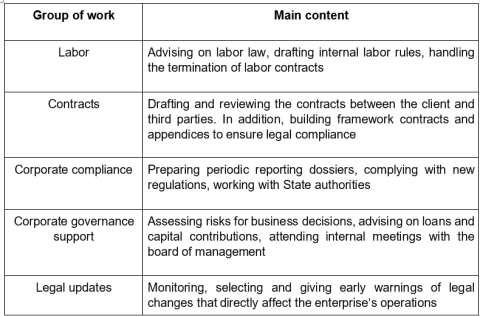
Through these distinct situations, the 03 enterprises above operate in 03 different fields and use legal services in different ways. However, there is one common point that none of the three uses legal retainer service only when an unusual event occurs. They use these services to support the business decisions taking place weekly and monthly, and to reduce legal risks in daily operations before those risks turn into major problems. The main difference between legal retainer services and the engagement of lawyers on a case-by-case basis lies in continuity and in the ability to understand the operations of the enterprise over time. Once lawyers have grasped the manner of operation, the records and the risk appetite of the enterprise, advice tends to be faster and closer to practice.
This is also what a proposal for legal retainer services can hardly express in full, because the value does not lie in the number of advisory hours each month but in the enterprise having a legal partner that accompanies it at all times, understands its operations clearly, follows the arising issues closely and stands ready to respond before an issue becomes serious.
The above is not official advice from BLawyers Vietnam. If you have any questions or suggestions about the above, please contact us at info@blawyersvn.com. BLawyers Vietnam would love to hear from you.
Date: 16 September 2026
Writers: Thanh Huynh & Huy Pham
