
Our Newsletter #26 would lead you on the following:
LEGAL UPDATE
I. Value-added tax reduction policy
On 30 June 2024, the Government issued Decree No. 72/2024/NĐ-CP (“Decree No. 72”) effective from 01 July 2024 to 31 December 2024, regulating the policy of reducing value-added tax (“VAT”) according to Resolution No. 142/2024/QH15 issued on 29 June 2024 with some notable points as follows:
1. Goods and services not eligible for VAT reduction
Decree No. 72 stipulates that VAT shall be reduced for goods and services subject to a 10% tax rate, except for the following goods and services:
- Telecommunications, financial activities, banking activities, securities, insurance, trading of real estate, metal and precast metal products, mining products (excluding coal mining), coke mining, refined oil, chemical products;
- Goods and services subject to excise tax, such as a gasoline business, nightclub business,…;
- Information technology products and services as prescribed in the information technology law, such as a computer business, peripheral equipment business,…;
- Accordingly, VAT on goods and services mentioned above shall be reduced consistently in all stages, including import, production, processing and trading.
- Coal products mined for sale (including coal products mined and then washed, sieved and classified according to a closed process before being sold) are subject to VAT reduction. Coal products listed in Appendix I of Decree No. 72 at stages other than mining and selling are not subject to VAT reduction.
- Coal products produced under a closed process of corporations and economic groups shall also be eligible for VAT reduction;
- If the above-mentioned goods or services are not subject to VAT or are subject to 5% VAT in accordance with the Law on value-added tax 2008, amended in 2016, VAT on that good or service shall be paid in accordance with the Law on value-added tax 2008, amended 2016, and shall not be reduced.
2. VAT reduction rates
According to Decree No. 72, the VAT reduction rates applied to the subjects mentioned in Item I.1 are specifically regulated as follows:
- Business establishments that pay VAT using the credit-invoice method shall pay 8% VAT on the goods and services specified in Item I.1 mentioned above; and
- Business establishments (including household businesses and individual businesses) that pay VAT using the percentage method on revenue shall be eligible for a 20% reduction of the percentage (%) for calculating VAT when issuing invoices for goods and services eligible for VAT reduction specified in Item I.1 mentioned above.
3. Implementation procedure
In order to implement VAT reduction, subjects specified in Item I.1 shall carry out the procedure prescribed in Decree No. 72 as follows:
- For business establishments mentioned in Item I.2.(i), when issuing VAT invoices for goods and services eligible for VAT reduction, write “8%” on the VAT rate line; VAT amount payable; total amount payable by the buyer.
- Accordingly, the goods seller or service provider shall declare output VAT, and the goods buyer or service user shall declare and deduct input VAT based on the reduced tax amount recorded on VAT invoices.
- If the business establishment mentioned in Item I.2.(i) sells or provides goods or services subject to different tax rates, then the VAT invoice must clearly state the tax rate of each good or service;
- For business establishments mentioned in Item I.2.(ii), when issuing VAT invoices for goods and services eligible for VAT reduction, write the amount before reduction in the “Amount” column, write the amount reduced by 20% of the percentage (%) on revenue in the “Total amount of goods, services” line, and note: “reduced… (the amount) equivalent to 20% of the % rate to calculate VAT according to Resolution No. 142/2024/QH15”.
- If the business establishment mentioned in Item I.2.(ii) sells goods or provides services, then the sales invoice must clearly state the amount of discount;
- If the business establishment has issued an invoice and declared according to the tax rate or percentage to calculate VAT that has not been reduced according to Decree No. 72, then the seller and the buyer shall process the issued invoice according to the law on invoices and records. Based on the invoice after processing, the seller shall adjust output VAT and the buyer shall adjust input VAT (if any); and
- Business establishments regulated in Decree No. 72 shall submit the declaration of their goods and services that are eligible for VAT reduction using VAT Reduction Form according to Resolution No. 142/2024/QH15 together with the VAT return form.
II. Adjusting statutory minimum wages paid to employees working under employment contracts
On 30 June 2024, the Government issued Decree No. 74/2024/NĐ-CP (“Decree No. 74”) effective from 01 July 2024, regulating the statutory minimum wages per month and the statutory minimum wages per hour paid to employees working under employment contracts, replacing Decree No. 38/2022/NĐ-CP (“Decree No. 38”) with some notable points as follows:
1. Regulated entities
Decree No. 74 applies to the following specific entities:
- Employees who work under employment contracts according to the Labor Code 2019;
- Employers according to the Labor Code 2019, including:
- Enterprises under the Law on Enterprises 2020;
- Authorities, organizations, cooperatives, households, or individuals that employ other people under agreements; and
- If employers are individuals, they must have full legal capacity.
- Other authorities, organizations and individuals involved in implementing the statutory minimum wages stipulated in Decree No. 74.
2. Increase the region-based statutory minimum wages
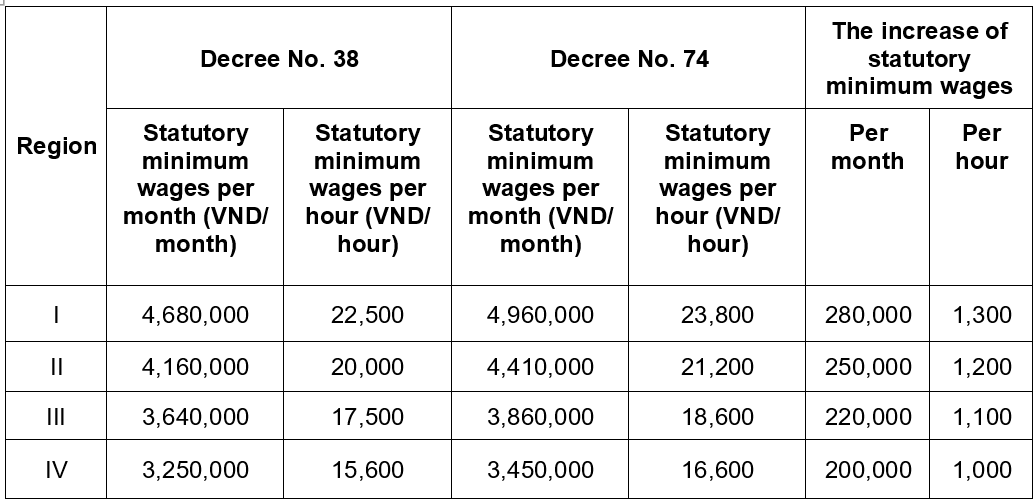
According to Decree No. 74, employees working for employers are entitled to new region-based statutory minimum wages, increased compared to Decree No. 38, specifically as follows:
3. Adjust the region applying statutory minimum wages
According to Decree No. 74, regions applying statutory minimum wages under Region I, Region II, Region III and Region IV are specifically regulated in the Appendix within Decree No. 74. Some regions have undergone changes compared to Decree No. 38, specifically as follows:
- Add to Region I the following administrative division:
- Uong Bi City, Mong Cai City, Quang Yen Town, Dong Trieu Town in Quang Ninh Province;
- Hai Duong City in Hai Duong Province;
- Thong Nhat District in Dong Nai Province; and
- Tan An City and Duc Hoa, Ben Luc, Can Giuoc Districts in Long An Province.
- Add to Region II the following administrative division:
- Bac Giang City, Viet Yen Town and Yen Dung District in Bac Giang Province;
- Chi Linh City, Kinh Mon Town and Cam Giang, Binh Giang, Tu Ky, Gia Loc, Nam Sach, Kim Thanh Districts in Hai Duong Province;
- Thai Binh City in Thai Binh Province;
- Thanh Hoa, Sam Son Cities and Bim Son, Nghi Son Towns in Thanh Hoa Province;
- Ninh Hoa Town in Khanh Hoa Province;
- Kien Tuong Town in Long An Province; and
- Soc Trang City in Soc Trang Province.
- Add to Region III the following administrative division:
- Ninh Giang, Thanh Mien, Thanh Ha Districts in Hai Duong Province;
- Thai Thuy, Tien Hai Districts in Thai Binh Province;
- Trieu Son, Tho Xuân, Yen Dinh, Vinh Loc, Thieu Hoa, Ha Trung, Hau Loc, Nga Son, Hoang Hoa, Nong Cong Districts in Thanh Hoa Province; and
- Ninh Phuoc District in Ninh Thuan Province.
4. Application of statutory minimum wages
Decree No. 74 regulates the application of statutory minimum wages for employees as follows:
- The statutory minimum wage per month is the minimum wage used as a basis for negotiation and payment of wages to employees applying the monthly wage payment method. This ensures that the wage according to the job or position of the employee who works enough hours in the month and completes the agreed labor of work norms must not be lower than the statutory minimum wage per month;
- The statutory minimum wage per hour is the minimum wage used as a basis for negotiation and payment of wages to employees applying the hourly wage payment method. This ensures that the wage according to the job or position of the employee who works for one hour and completes the agreed labor or work norms must not be lower than the statutory minimum wage per hour;
- For employees who are paid weekly or daily or piecework pay or predetermined payment, the salary of these forms of payment, if converted to monthly or hourly must not be lower than the statutory minimum wage per month or the statutory minimum wage per hour. The salary converted to monthly or hourly based on normal working hours chosen by the employer is specifically stipulated as follows:
- The monthly salary is equal to the weekly salary multiplied by 52 weeks divided by 12 months; or the daily salary multiplied by the number of normal working days in a month; or the piecework salary or predetermined salary performed during normal working hours in a month; and
- Hourly wage is converted by weekly or daily wage divided by normal working hours per week or day; or by the piecework salary or predetermined salary divided by normal working hours to produce products or perform contracted tasks.
III. Mechanisms for direct electricity trading between renewable energy generation units and large electricity consumers
On 03 July 2024, the Government issued Decree No. 80/2024/ND-CP (“Decree No. 80”) effective from 03 July 2024, regulating the mechanisms for direct electricity trading between Renewable energy generation units and large electricity consumers (“Consumer”) through Private connection lines and the National grid with some notable points as follows:
1. Regulated entities
Direct electricity trading is regulated by Decree No. 80 and applies to the following specific subjects:
- Entities involved in power trading through Private connection lines include:
- Renewable energy generation units; and
- The Consumer.
- Entities involved in electricity trading through the National grid include:
- Renewable energy generation units from wind or solar with a capacity of 10 MW or more connected to the national power system directly participate in the competitive wholesale electricity market;
- Consumer using electricity for production purposes purchasing electricity from the Power Corporation or other electricity retailers that are not the Power Corporation connecting electricity with voltage levels from 22kV or higher; and
- Electricity retailers in zones and clusters authorized by the Consumer using electricity for production purposes purchase electricity from the Power Corporation, signing forward power purchase agreements with Renewable energy generation units (hereinafter referred to as “Authorized electricity retailers in zones and clusters”).
- Other entities, including:
- Electricity system and market operation units;
- Electricity transmission units;
- The Power Corporation of Vietnam Electricity and other electricity retailers; and
- Vietnam Electricity.
2. Direct electricity trading mechanisms
According to Decree No. 80, direct electricity trading is the activity of buying, selling and receiving electricity, carried out through 2 following forms:
- Direct electricity trading through Private connection lines is the activity of signing an electricity trading contract and delivering electricity through Private connection lines between Renewable energy generation units and the Consumer.
- Consequently, the electricity price agreed on by both parties, except for when electricity units perform both the electricity generation function and the retail function in zones and clusters. The electricity units also purchases electricity from the national grid and other local electricity sources for electricity retail to consumers in zones and clusters. Such retail price of electricity for consumers must be implemented according to the Regulation on the implementation of electricity prices issued by the Ministry of Industry and Trade;
- Direct electricity trading through the National grid is the activity of buying and selling electricity through forward power purchase agreements between Renewable energy generation units and the Consumer (or the Authorized electricity retailers in zones and clusters). This electricity trading activity includes:
- Renewable energy generation units selling all of their produced electricity to the spot electricity market in the competitive wholesale electricity market;
- The Consumer or the Authorized electricity retailers in zones and clusters signs an electricity trading contract with the Power Corporation (or authorized/assigned units) to purchase all of the electricity meeting their demands; and
- Renewable energy generation units and the Consumer or the Authorized electricity retailers in zones and clusters trading electricity through a forward power purchase agreement.
Accordingly, the spot electricity market price is the total electricity market price formed according to each trading cycle of the spot electricity market and is determined by the sum of the market electricity price and the market capacity price. The market electricity price and the market capacity price are determined based on the Regulation on the operation of the competitive wholesale electricity market issued by the Ministry of Industry and Trade.
The above is not official advice from BLawyers Vietnam. If you have any questions or suggestions about the above, please contact us at info@blawyersvn.com. BLawyers Vietnam would love to hear from you.
Date: 30 September 2024
Writer: BLawyers Vietnam
Legal News and Update Team
PUBLISHED ARTICLES
- 16 FAQ about foreign contractors implementing construction investment projects in Vietnam (Part 1)
- 3 common inquiries about e-commerce applications in Vietnam
- Licenses needed when engaging in importation and wholesale distribution of used electric cars in Vietnam
- Portal for the housing and real estate market information system in Vietnam: essential data for investors (Part 1)
DIGITAL AUDIO PROGRAM
PUBLISHED LEGAL NEWSLETTERS
CONTACT US
✍ Legal News and Update Team
📩 legalnews@blawyersvn.com
For Downloading:
Maybe you are interested in reading other Newsletters of BLawyers Vietnam: Legal Newsletter in May 2024/ Legal Newsletter in June 2024/ Legal Newsletter in July 2024
